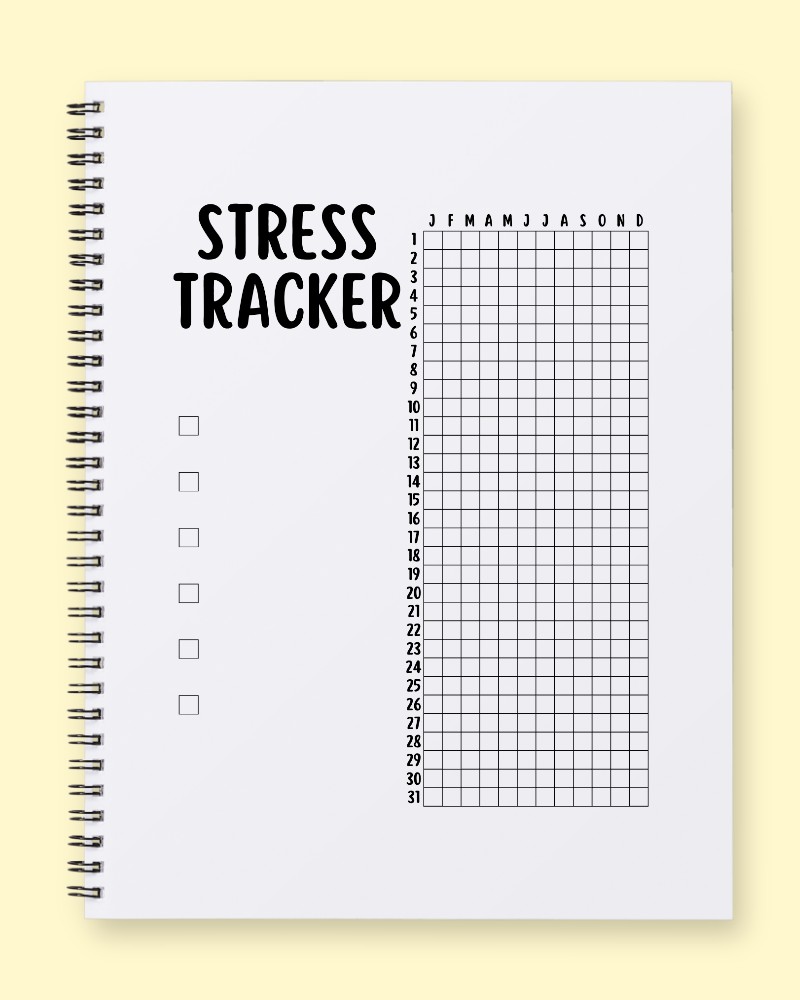
Managing stress is a cornerstone of mental well-being, and a dedicated stress tracker can be an incredibly powerful tool in this journey. This "Stress Tracker" journal page provides an intuitive, comprehensive framework for monitoring your daily stress levels over an entire year. Designed as a crisp, printable template for a spiral-bound notebook, its clear grid layout, complete with days 1-31 and months J-D, offers an immediate visual snapshot of your emotional landscape. The additional unlabelled checkboxes on the left provide versatile space for a personalized key or tracking supplementary habits. Whether you're aiming to identify triggers, celebrate progress, or simply cultivate greater self-awareness, this annual stress tracker is your companion for a more mindful year.
The Psychological Benefits of Your Annual Stress Tracker
This particular stress tracker template offers profound psychological advantages due to its unique annual grid design and customizable elements. Firstly, the long-term visual overview (31 days across 12 months) allows for immediate pattern recognition that shorter trackers simply cannot provide. You can effortlessly spot seasonal stress, recurring monthly stressors (e.g., related to work deadlines or personal anniversaries), or persistent periods of high or low stress. This overarching perspective fosters a deeper understanding of your body's and mind's responses to life's ebb and flow.
Secondly, the act of daily marking promotes mindfulness and self-awareness. Each time you fill a cell, you're prompted to pause, reflect on your day, and honestly assess your internal state. This regular introspection cultivates emotional intelligence, helping you become more attuned to the subtle cues of stress before they escalate. You move from a reactive state to a proactive one.
Furthermore, by externalizing your stress levels onto the page, you gain a sense of objectivity and control. What once felt like an amorphous, overwhelming feeling becomes quantifiable data. This empowers you to identify specific triggers – be it a particular day of the week, a recurring task, or an interpersonal dynamic – and develop targeted coping strategies. The presence of the unlabelled checkboxes beneath the main title also serves as a subtle prompt for goal integration and positive habit formation. They can be used to track specific stress-reducing activities, reinforcing the commitment to self-care and demonstrating the direct impact of these practices on your stress levels over time.
Your Step-by-Step Guide to Filling Out the Stress Tracker Effectively
Making the most of your "Stress Tracker" involves a systematic yet flexible approach tailored to its visual components:
-
Define Your Stress Scale (Using Checkboxes): Utilize the six unlabelled checkboxes on the left side to create a personalized legend for your stress levels. For optimal visual clarity, a color-coding system is highly recommended. For instance:
- Checkbox 1: Light Green – Very Low Stress/Relaxed
- Checkbox 2: Green – Mild Stress/Manageable
- Checkbox 3: Yellow – Moderate Stress/Noticeable
- Checkbox 4: Orange – High Stress/Challenging
- Checkbox 5: Red – Very High Stress/Overwhelming
- Checkbox 6: (Optional) Leave blank for a custom symbol (e.g., "X" for missed day) or for tracking a key coping mechanism used. Write a small description or draw the color beside each checked box.
-
Choose Your Marking Method: Once your legend is set, decide how you'll mark the grid cells. A small colored dot, a shaded box, or a tiny initial (e.g., "VL," "M") corresponding to your defined scale works best. Colors offer the most immediate visual impact when reviewing patterns.
-
Daily Check-In: At the end of each day, or at a consistent time that suits you, take a moment to reflect on your overall stress level for that day. Locate the correct row (corresponding to the day of the month, 1-31) and the correct column (for the current month, J-D). Fill in the cell according to your chosen stress scale and marking method. Consistency is key here!
-
Leverage the Annual View: Don't just fill and forget. The brilliance of this tracker lies in its annual scope. As months pass, you'll intuitively begin to notice horizontal patterns across a single month (how stress fluctuates within a 31-day cycle) and vertical patterns down a specific day number across the year (e.g., is the 15th of every month always stressful?).
-
Review and Reflect Periodically: Set aside time weekly, monthly, or quarterly to consciously review the filled sections. Ask yourself: What days or months show higher stress? What activities or circumstances correlated with those periods? What coping strategies were successful during lower stress times? This reflection transforms data into actionable insights.
Three Daily Prompts to Enhance Your Stress Tracking Journey
To maximize the benefits of your "Stress Tracker" and move beyond mere data entry, incorporate these reflective prompts into your routine:
-
Pre-Marking Reflection: "Before I mark today's cell, what was the most significant stressor I faced today? Conversely, what was one moment of calm or joy, and how did I contribute to it? (Think about the actions that influenced your stress level for the day, for better or worse, before assigning a color.)"
-
Mid-Month Pattern Spotter: "Looking at this month's column so far, what color or symbol appears most frequently? What does this immediately tell me about my overall emotional state this month? If there are clusters of high stress, what events preceded them, and what single change could I initiate tomorrow to shift that pattern?"
-
Action-Oriented Trend Analysis: "Observing the past few months, I notice a recurring pattern of [e.g., high stress on Mondays, or low stress after yoga]. Based on this specific visual data, what is one actionable step I can take this week to either avoid a known stressor or intentionally create more moments of calm, directly influenced by what my tracker is showing me?"
By engaging with these prompts, you transform your stress tracker from a simple log into a powerful self-coaching tool, guiding you towards greater resilience and well-being throughout the year.