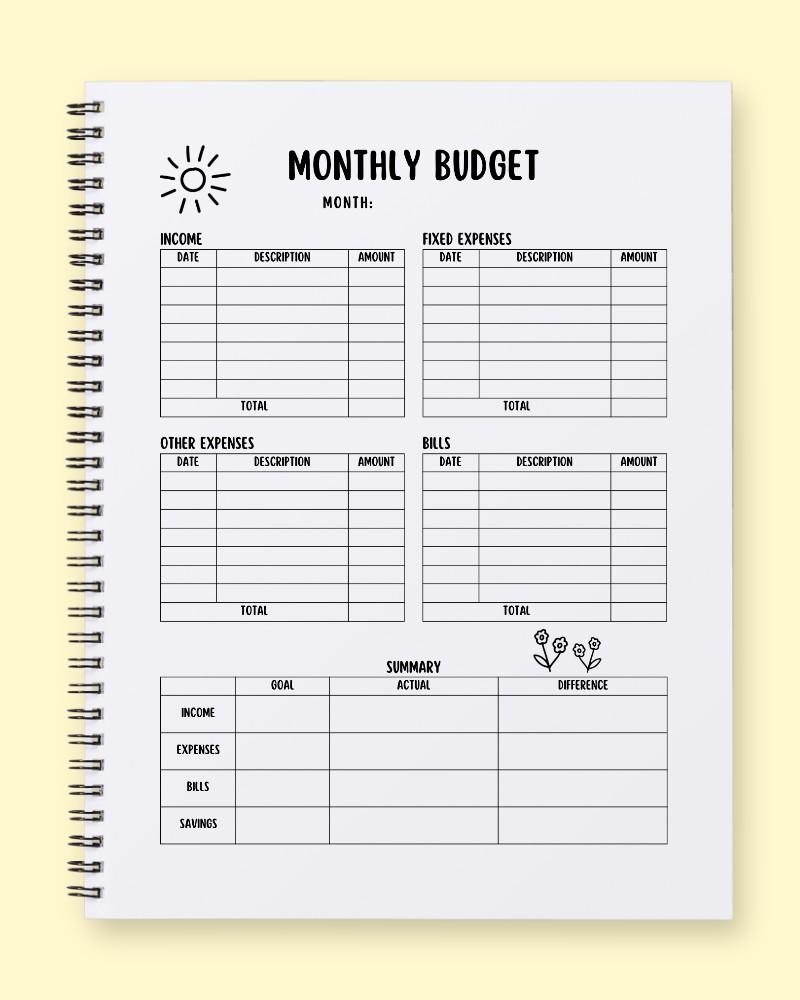
Empower Your Wallet: Monthly Budget Planner Template
Unlocking financial control has never been more straightforward or visually appealing than with this intuitive Monthly Budget Planner Template. Designed for clarity and ease of use, this printable journal page transforms the often-daunting task of money management into an organized, empowering habit. From tracking every dollar earned to meticulously categorizing expenditures, this template provides a comprehensive overview of your financial landscape, ensuring you stay on track towards your savings goals and overall financial well-being. Whether you're a seasoned budgeter or just starting your personal finance journey, this beautifully structured planner is your essential companion for achieving financial peace of mind.
1. The Psychological Benefits of This Specific Budget Tracker
This Monthly Budget Planner goes beyond simple number crunching, offering profound psychological advantages through its thoughtful design. The clear division into "INCOME," "FIXED EXPENSES," "OTHER EXPENSES," and "BILLS" reduces cognitive load, preventing overwhelm often associated with financial tracking. This segmentation allows users to compartmentalize their finances, making it easier to digest and manage. The inclusion of a "TOTAL" line in each section provides immediate gratification and a clear understanding of spending within each category.
Crucially, the "SUMMARY" section, featuring "GOAL," "ACTUAL," and "DIFFERENCE" columns for Income, Expenses, Bills, and Savings, fosters a powerful sense of accountability and motivation. Setting specific goals empowers users to envision their financial future, while tracking actuals allows for honest self-assessment. The "Difference" column acts as a tangible feedback loop, highlighting successes or areas needing adjustment, encouraging a growth mindset rather than dwelling on perceived failures. The clean, uncrowded layout and simple graphical elements (like the sun and flowers) make the process feel less like a chore and more like an enjoyable, empowering step towards financial freedom. The implied physical act of writing in a spiral-bound planner enhances engagement and memory retention, cementing financial habits more effectively than purely digital methods.
2. A Step-by-Step Guide to Filling Out Your Monthly Budget Planner
Utilizing this Monthly Budget Planner effectively is simple with a structured approach:
- Set the Stage: Begin by filling in the
MONTH:line at the top of the page. This anchors your budget to a specific period. - Detail Your Income: In the
INCOMEsection, list every source of income. Use theDATE,DESCRIPTION(e.g., "Paycheck - Main Job," "Freelance Project"), andAMOUNTcolumns. Sum all your income at the bottom in theTOTALline for a clear overall picture. - Identify Fixed Expenses: Move to
FIXED EXPENSES. These are costs that typically don't change month-to-month, such as rent/mortgage, car payments, or streaming subscriptions. Fill in theDATE,DESCRIPTION, andAMOUNT, then calculate theTOTAL. - Track Other Expenses: The
OTHER EXPENSESsection is for variable spending like groceries, dining out, entertainment, fuel, and personal care. Record these as they occur throughout the month, using theDATE,DESCRIPTION, andAMOUNTcolumns. Tally theTOTALat month-end. - Categorize Your Bills: Use the
BILLSsection for utilities (electricity, water), credit card payments, or insurance premiums. These might vary slightly but are generally predictable. Fill inDATE,DESCRIPTION, andAMOUNT, then total them up. - Set Your Summary Goals: Before the month begins (or early in the month), turn your attention to the
SUMMARYtable. Based on your financial aspirations, enter yourGOALamounts forINCOME,EXPENSES(sum of Fixed and Other),BILLS, and critically,SAVINGS. - Calculate Actuals & Differences: At the end of the month, transfer your calculated
TOTALfigures from each top section to theACTUALcolumn in theSUMMARYtable. Calculate yourACTUALSAVINGSbased onIncome Actual - (Fixed Expenses Total + Other Expenses Total + Bills Total). Finally, compute theDIFFERENCEfor each row (Actual - Goal), revealing where you exceeded expectations or need to adjust next month.
3. Three Daily Prompts That Pair Well With This Layout
To enhance your budgeting routine and leverage this planner's structured layout, integrate these daily prompts:
-
"Review today's 'Other Expenses' (if any). Was this purchase intentional, or an impulse? How does it align with my broader 'SUMMARY' savings goal for the month, and where could I potentially adjust future spending in this category?" This prompt encourages mindful spending by directly referencing the variable
OTHER EXPENSESsection and connecting it to the larger financial vision in theSUMMARYtable. It fosters self-awareness regarding non-essential outgoings. -
"Looking ahead to my 'FIXED EXPENSES' and 'BILLS' due within the next week, am I adequately prepared? Are there any recurring subscriptions or payments I should consider reviewing, renegotiating, or canceling to improve my overall 'DIFFERENCE' in these categories?" This prompt promotes proactive financial management by focusing on the predictable but often overlooked recurring costs. It encourages users to think critically about these obligations rather than passively paying them.
-
"Considering my current 'INCOME' for the month and a quick glance at my 'SUMMARY' table's 'ACTUAL' column so far, what one small, actionable step can I take today to positively impact my 'SAVINGS' goal or reduce a negative 'DIFFERENCE' in any expense category?" This forward-looking prompt encourages immediate action and connects daily habits to long-term financial health. By referencing
INCOMEand theSUMMARY, it prompts users to find small ways to optimize their budget, reinforcing a sense of control and progress.
Explore Our Resources
Explore free printable planners, journals, and trackers to stay organized, build better habits, and simplify your daily routine. Practical tools and guides designed for real life.