Master Your Money: Daily & Yearly Spending Tracker
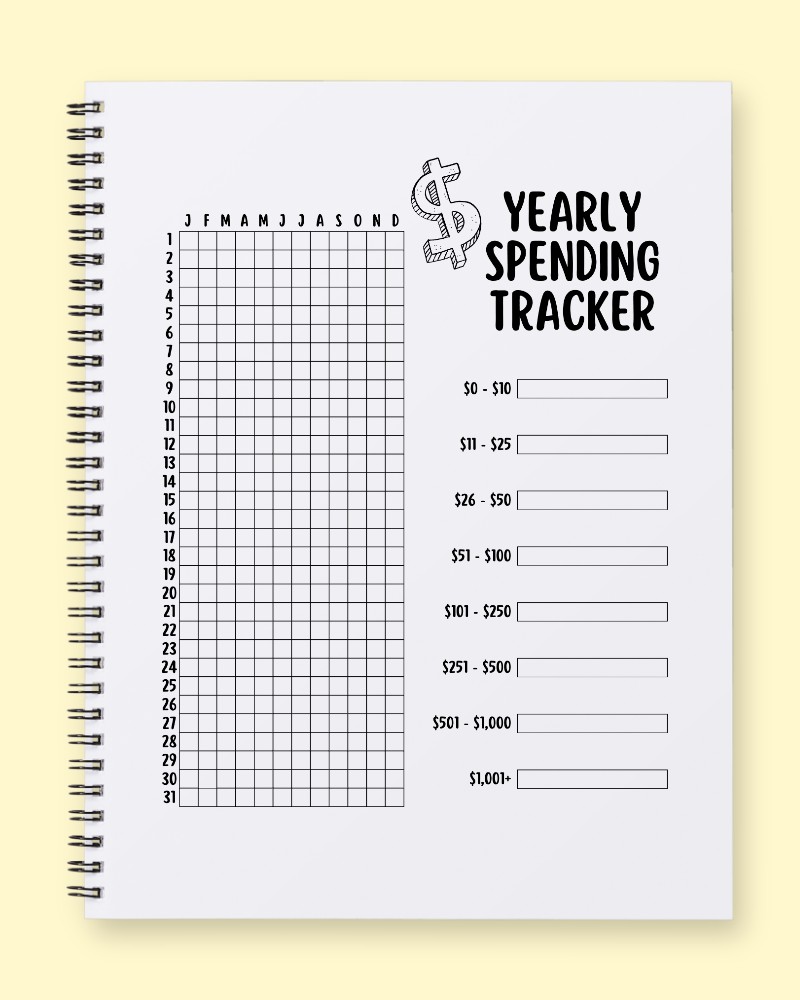
This "Yearly Spending Tracker" journal page is more than just a grid; it's a powerful tool designed to transform your financial relationship. By providing a clear, visual overview of your spending habits throughout the year, it empowers users to gain insight, develop discipline, and work towards financial freedom. This printable, wire-bound journal layout offers a tangible, effective way to manage your money beyond digital apps.
1. The Psychological Benefits of Using This Specific Tracker
The meticulously organized layout of this yearly spending tracker offers profound psychological advantages. The prominent "Yearly Spending Tracker" title and the charming dollar sign icon immediately set a purpose-driven tone for financial stewardship. The core benefit lies in its visual simplicity: a grid featuring days 1-31 vertically and months J-D horizontally. This structure transforms a daunting year of expenses into manageable, daily actions. Each marked square provides a concrete, visual representation of progress, fostering a sense of accomplishment and control over one's finances – a potent antidote to financial anxiety. Regularly filling in a square instills a powerful daily habit, moving users from reactive spending to proactive financial mindfulness.
Moreover, the right-hand legend with distinct spending categories ($0-$10, $11-$25, $26-$50, $51-$100, $101-$250, $251-$500, $501-$1,000, $1,001+) encourages deeper introspection. Instead of just noting an expense, users categorize it, creating a mental framework for their financial outlay. This categorization, especially when paired with a color-coding system (as suggested below), allows for immediate pattern recognition. Seeing a streak of 'red' (for higher spending) or 'green' (for lower spending) across the grid can be a powerful motivator for behavioral change. This tracker doesn't just record; it facilitates self-discovery, helping you understand triggers for overspending and celebrate consistent saving, ultimately bolstering financial literacy and confidence.
2. A Step-by-Step Guide on How to Fill It Out Effectively
Utilizing this "Yearly Spending Tracker" to its full potential is straightforward and highly customizable:
-
Establish Your Legend: Begin by personalizing the spending categories on the right-hand side. The blank lines next to each range are perfect for assigning a unique color or simple symbol. For instance:
- $0-$10: Light Green (for minimal spending days)
- $11-$25: Dark Green
- $26-$50: Yellow
- $51-$100: Orange
- $101-$250: Light Red
- $251-$500: Dark Red
- $501-$1,000: Purple
- $1,001+: Black (for significant expenses)
- You can also use these lines to tally the number of days you fall into each category per month or even track the total sum spent in each range over the year.
-
Daily Recording Ritual: At the end of each day, consolidate your total spending for that 24-hour period. This includes all cash, card, and digital transactions.
-
Mark Your Grid: Locate the intersection of the current day (left column) and the current month (top row) on the main grid. Using your established color or symbol from step 1, fill in or mark this square to represent your total daily spending range. For example, if you spent $35 today on the 15th of January, you would locate '15' on the left, 'J' at the top, and fill in that square with your designated 'Yellow' color.
-
Monthly and Yearly Review: At the end of each month, take a moment to scan across the corresponding month's column. Are there clusters of high-spending days? Are there consistently low-spending days? This visual feedback is invaluable. At year-end, the entire grid provides a powerful infographic of your spending narrative, helping you identify annual trends and set informed financial goals for the future.
3. Three Daily Prompts That Pair Well With This Layout
To enhance the tracking process and truly integrate mindful spending, consider these daily reflection prompts:
- "Today's Spending Snapshot: Which category did I land in, and what was the main expense contributing to it?" This prompt directly engages with the tracker's categories. It encourages you to articulate your primary spending, linking the recorded color/symbol back to the actual purchase, fostering transparency and accountability with your money.
- "One spending choice I made today: Was it a need, a want, or an investment? How did it make me feel?" This prompt encourages a deeper emotional and practical evaluation of spending. By categorizing the type of spending and reflecting on its impact, you build awareness of your purchasing motivations and whether they align with your values and financial goals.
- "Looking at my day's spending on the grid, what's one small adjustment I can make tomorrow to nudge myself towards a lower spending category (or maintain it)?" This prompt leverages the visual feedback of the grid for immediate, actionable steps. It promotes continuous improvement by asking for a forward-looking strategy based on today's financial performance, reinforcing positive budgeting habits for the entire year.
Explore Our Resources
Explore free printable planners, journals, and trackers to stay organized, build better habits, and simplify your daily routine. Practical tools and guides designed for real life.