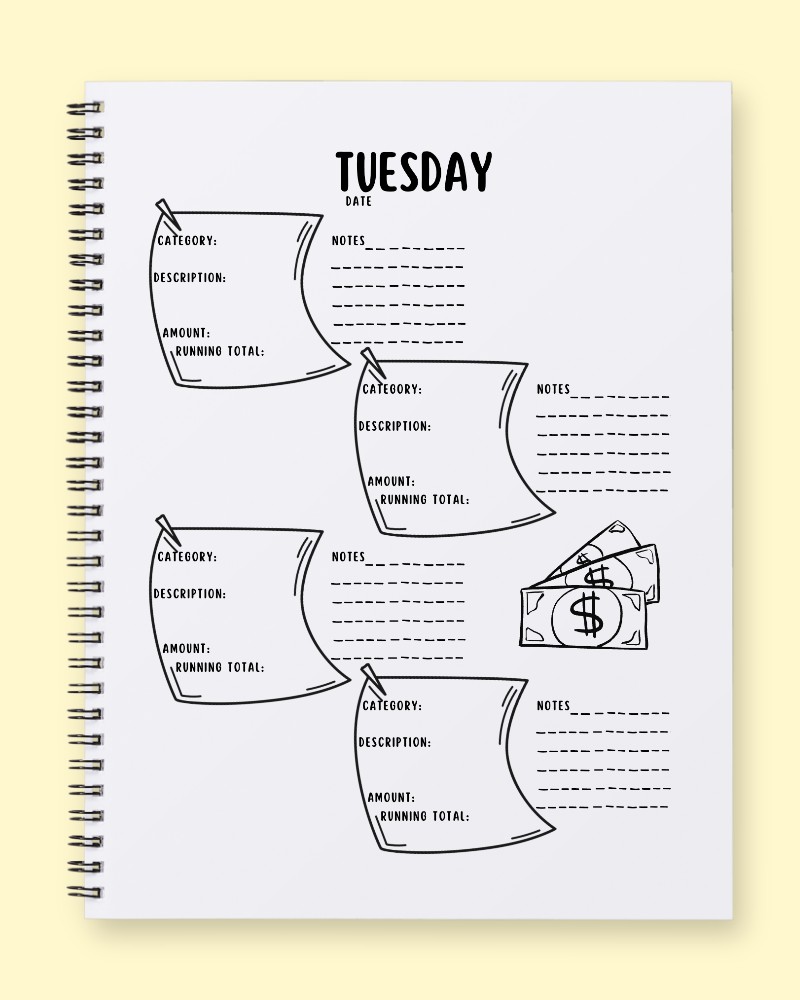
Unlocking financial awareness and peace of mind is within reach with the Daily Spending & Insight Journal. This thoughtfully designed page isn't just about numbers; it's a holistic tool for understanding your financial flow, day by day, and how it intersects with your well-being. Crafted for daily reflection, this specific layout transforms mundane transaction tracking into a powerful personal growth practice.
The Psychological Benefits of Using This Specific Tracker/Planner
This journal page, with its unique "torn paper" transaction entries and dedicated note sections, offers significant psychological advantages. Firstly, the structured yet organic visual layout (four distinct, pin-secured entries) provides a sense of control over your finances without feeling rigid or overwhelming. Each defined space encourages mindfulness for every transaction, preventing the dreaded "where did my money go?" feeling.
The inclusion of fields like "CATEGORY" and "DESCRIPTION" for each of the four daily slots combats financial anxiety by bringing clarity and order to your spending. This categorization and detailed description fosters a deeper understanding of spending patterns, allowing you to identify habits, both good and bad, reducing the mental burden of vague financial worries. You're not just recording; you're analyzing on the fly.
Crucially, the "RUNNING TOTAL" field offers immediate gratification or gentle correction. Seeing your balance adjust in real-time provides instant feedback, encouraging responsible spending and reducing impulse purchases. This continuous feedback loop cultivates financial discipline and empowers you to make conscious choices throughout your day.
Furthermore, the dedicated "NOTES" section adjacent to each transaction entry is a game-changer. It transforms a simple ledger into a reflective diary. Here, you can jot down the emotional context of a purchase ("treated myself after a tough meeting"), its necessity ("emergency car repair"), or future plans ("need to re-stock pantry next week"). This specific feature allows you to connect your finances to your emotions and daily life, promoting self-awareness and reducing stress by acknowledging the 'why' behind the 'what.' The "TUESDAY" heading keeps your focus on a single, manageable day, preventing burnout often associated with long-term budgeting.
A Step-by-Step Guide on How to Fill It Out Effectively
This Daily Spending & Insight Journal is designed for intuitive use, turning daily financial logging into a valuable ritual.
- Start Your Day: Begin by filling in the "DATE" under "TUESDAY." This anchors your financial activity to a specific point in time.
- First Transaction Capture: When you make your first financial movement (expense or income), utilize one of the four unique "torn paper" entry slots.
- CATEGORY: Assign a clear, concise category (e.g., "Groceries," "Fuel," "Coffee," "Freelance Income"). Be consistent.
- DESCRIPTION: Provide specifics (e.g., "Morning latte at Cafe X," "Weekly shop at MegaMart," "Payment for design project"). The more detail, the better for later review.
- AMOUNT: Enter the numerical value. For expenses, consider using a negative sign or consistent formatting to distinguish from income.
- RUNNING TOTAL: Immediately update your current balance. This is vital for real-time financial awareness. If you start the day with a certain amount, subtract expenses and add income to get your new total.
- Harness the Notes Section: This is where the magic happens. Directly alongside your transaction details, use the dashed lines in the "NOTES" section. This space is for context:
- Why did you make this purchase? ("Needed new work shoes.")
- How did it make you feel? ("Guilty, but it was essential.")
- Any related thoughts or plans? ("Remember to check for sales next time.")
- Was it unexpected? ("Impulse buy after seeing a discount.")
- Repeat for Subsequent Movements: Continue filling out the remaining three entry slots throughout "Tuesday" as you incur expenses or receive income. The four distinct spaces are ample for tracking key daily financial events without feeling cluttered.
- Daily Review and Reflection: Before ending your day, take a moment to review all entries. The visual cue of the stacked dollar bills reinforces the financial purpose. Ask yourself: Did I stick to my plan? What patterns emerged? This review solidifies learning and prepares you for the next day.
Three Daily Prompts That Pair Well With This Layout
To maximize the insights gained from your Daily Spending & Insight Journal, integrate these prompts into your "Tuesday" routine, particularly leveraging the "NOTES" sections.
-
"Today, pinpoint one transaction where your 'want' truly aligned with a 'need.' Use the 'NOTES' section to reflect on why this purchase felt right and how it contributed positively to your day or goals."
- How it pairs: Fill out the CATEGORY, DESCRIPTION, AMOUNT, and RUNNING TOTAL for this specific transaction. The "NOTES" area then becomes a dedicated space for profound reflection, connecting your financial choices to personal well-being and satisfaction. This encourages mindful spending on items that genuinely add value.
-
"Review your 'Running Total' across all entries. Based on today's spending, what is one small, actionable financial adjustment you can make tomorrow to improve your 'Running Total' further? Jot down this action in a 'NOTES' section."
- How it pairs: This prompt encourages a forward-looking perspective. After tallying your day's financial flow, choose one of the available "NOTES" sections (perhaps the last one for summary) to brainstorm and commit to a specific, measurable action for the following day (e.g., "Pack lunch tomorrow," "Delay coffee purchase by an hour," "Check for loyalty points before buying"). It turns reflection into proactive planning.
-
"Consider an expense today that surprised you, either by its cost or its necessity. In the associated 'NOTES' section, explore the root cause of this surprise and identify one preventative measure you could take in the future."
- How it pairs: Select the relevant transaction and complete the CATEGORY, DESCRIPTION, AMOUNT, and RUNNING TOTAL. The "NOTES" section then serves as a mini-incident report and problem-solving space. This helps in understanding unexpected spending, whether it's an impulse buy or an unforeseen need, and guides you toward more predictable financial habits, reducing future "surprises."